
Frequently Asked Questions

Frequently Asked Questions

Choosing the right school is one of the most important decisions a family makes. To help you get to know us, we’ve answered the questions we hear most often from parents. The questions are grouped by stage — simply jump to the stage your child is in, or start with “About Our School” for an overview. You’ll notice some questions appear in more than one stage; that’s intentional, so each section stands on its own. If your question isn’t covered here, our admissions team is always happy to help.

For families of children in FS1 and FS2 (ages 3–4).

Our Foundation Stage follows the British Early Years Foundation Stage (EYFS) framework, enriched with Islamic values, the Arabic language and UAE culture. Learning is play-based and hands-on, building the communication, early literacy, numeracy and social skills that give children a strong and happy start. We are fully compliant with the KHDA’s requirement to place the Arabic language and Islamic Studies at the core of the early years curriculum, so children grow in faith and language from their very first days with us.

Children can join FS1 from age 3 and FS2 from age 4. A child’s year group is set by the age they reach by 31 December of the entry year, in line with KHDA guidelines — so your child should turn 3 (for FS1) or 4 (for FS2) by 31 December. Our admissions team will happily confirm the right starting point for your child.

Starting school is a big step for little ones. We ease the transition with a gentle, staggered start and close partnership with parents in the first days, so children feel safe, secure and ready to explore. Our early years team is experienced in helping every child build confidence and independence.

Yes. Children joining the Foundation Stage should be toilet-trained before they start, as nappies are not used in school. If you have any concerns, our admissions and early years teams are glad to offer guidance ahead of your child’s start date.

We teach early reading and writing through Read Write Inc., a proven synthetic phonics programme, brought to life with songs, stories and multi-sensory activities. Alongside phonics, we develop children’s speaking, listening and fine-motor skills, laying strong foundations for confident reading and writing. You can read more about the programme here: Read Write Inc. Phonics.

Faith and language are part of everyday life from the very beginning. Young children are gently introduced to Arabic, to Islamic values through daily routines and kindness, and to the Quran through simple recitation and memorisation appropriate to their age.

In the early years, assessment is based on observation rather than formal tests. Teachers track each child’s development through everyday learning and share regular updates and reports, so you always know how your child is getting on.

  • FS1 runs from 7:15 am to 12:30 pm, and FS2 from 7:15 am to 2:30 pm, Monday to Thursday.
  • On Fridays, both FS1 and FS2 finish at 11:10 am.

Yes. For the convenience of families, we offer a Siblings Club for children in FS1 who have older brothers or sisters at the school. It runs from 12:30 pm to 2:30 pm, so younger children can stay until their siblings finish for the day. There is a small additional charge, which we keep affordable — please speak to our registration team for details.

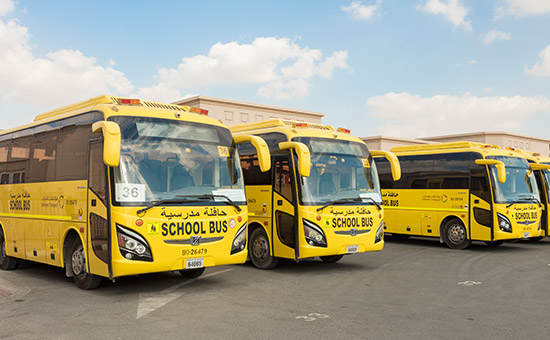
Yes — supervised school transport is available, with trained staff caring for our youngest students. We encourage healthy eating and operate a nut-free policy to keep all children safe; details of snack and meal arrangements are shared with families before your child starts.

For families of children in Years 1–6 (ages 5–10).

Primary follows the National Curriculum of England, enhanced with the UAE Ministry of Education subjects — Arabic, Islamic Education, Social Studies and Moral Education. Children study a broad, balanced range of subjects including English, Mathematics, Science, Computing, Humanities, Art and Physical Education.

All students study Arabic (as a first or additional language), together with the Ministry-mandated subjects of Social Studies and Moral Education; Islamic Education is taught to our Muslim students. The Quran is part of the curriculum during the school day, with recitation and memorisation taught to all children. In addition, our after-school Quran Academy — which runs three days a week — is open to students who wish to accelerate their memorisation and go further in their Quranic learning.

Progress is monitored continuously through everyday classwork, projects and quizzes, alongside standardised assessments that help us benchmark attainment. Parents receive regular written reports and updates, and we welcome ongoing conversation because we see education as a partnership.

Yes. Age-appropriate homework is set to reinforce learning and help children build good study habits. Establishing a simple routine and a quiet space at home makes a real difference, and teachers are always happy to advise.

Absolutely. We welcome children from many different systems and language backgrounds, and our teachers are experienced in helping new students settle, bridge any gaps and thrive. Where English is an additional language, we provide support to help children access their learning with confidence.

We are an inclusive school with a dedicated approach to additional learning needs. Children who need it receive tailored support and individual plans, developed in partnership with families, so that every child can make progress.

Learning extends well beyond the classroom, with a range of sports, creative, academic and faith-based activities. This includes our after-school Quran Academy, which runs three days a week for students who wish to deepen their memorisation and understanding of the Quran.

Our Primary day runs from 7:15 am to 2:30 pm, Monday to Thursday, and from 7:15 am to 11:10 am on Friday.
For families of students in Years 7–11 (ages 11–16).

In Years 7–9 (Key Stage 3) students follow a broad curriculum that builds the knowledge and skills for the next stage. In Years 10–11 (Key Stage 4) they work towards IGCSEs, sat with Pearson Edexcel, alongside vocational options. Our qualifications are awarded by leading UK boards, Pearson Edexcel and Cambridge International.

Students study a core of subjects — including English, Mathematics and the Sciences — and begin to choose options as they move into Key Stage 4. Our teachers and pastoral team guide each student in selecting a combination that suits their strengths and future ambitions. You can read more in our Key Stage 4 options booklet.

Yes. Alongside academic IGCSEs, we offer BTECs (vocational qualifications) awarded by Pearson, for example in Business and Sport. BTECs are practical and applied — assessed through coursework and projects rather than mainly by examination — and are a well-respected route into university and employment. Many students combine academic and vocational courses to build both depth and real-world skills.

Assessment combines continuous classwork, projects and mock examinations with the formal external examinations of the qualification years. Regular reports keep parents informed of progress and next steps.

Both are excellent pathways; the main differences are structure and assessment. The British system specialises earlier and is examination-based, with IGCSEs at 16, while the American system keeps a broader spread of subjects and builds a GPA from coursework. The British route rewards depth and subject mastery. Our team helps students transferring from an American school place into the right year group and settle quickly.

Guidance begins well before Sixth Form. Students receive support in understanding their options, subject choices and future pathways, so they can make confident, well-informed decisions about their next steps.

Pastoral care is central to secondary life. A dedicated team supports students’ personal development and wellbeing, and there are leadership opportunities — such as student council and prefect roles — that build confidence, responsibility and character.

Students can take part in the Duke of Edinburgh’s Award, which develops skills, resilience, teamwork and a spirit of service. We also run a regular programme of trips to broaden students’ horizons and build a wider perspective — including overnight trips, an annual Umrah, and other international travel — so students learn well beyond the classroom.

Yes. Arabic and the Ministry-mandated subjects continue throughout Secondary, and Islamic Education continues for our Muslim students. The Quran remains part of the curriculum during the school day, and our after-school Quran Academy — running three days a week — is there in addition, for students who wish to accelerate their memorisation and progress further.

Our Secondary day runs from 7:15 am to 2:30 pm, Monday to Thursday, and from 7:15 am to 11:10 am on Friday.
For families of students in Years 12–13 (ages 16–18).

In Sixth Form (Years 12–13) students study A-Levels, offered with Pearson Edexcel and Cambridge International, and may also take BTEC qualifications. Students typically specialise in three or four subjects, chosen to match their strengths and university ambitions.

Entry to Sixth Form is based on a student’s IGCSE results, with specific requirements that vary from subject to subject. For full details of the entry requirements for particular subjects, please see our Key Stage 5 booklet. Our team is also on hand to advise every student on the best combination of courses for their goals.

A-Levels are academic qualifications assessed mainly through examinations and studied in depth, while BTECs are practical, applied qualifications assessed largely through coursework and projects. Both carry UCAS points and are recognised by universities, and they can be combined — for example, A-Levels in academic subjects alongside a BTEC in Business or Sport.

Most students take three or four subjects in Sixth Form, allowing them to study in real depth. Our academic and careers teams help each student choose the combination that best supports their intended degree and career.

Sixth Form students receive dedicated guidance on university applications — including UCAS applications, personal statements and choosing the right course — whether they plan to study in the UAE, the UK or further afield.

A-Levels lead directly to university. Our students progress to universities in the UAE and internationally, well prepared by qualifications that are recognised and respected around the world.

Sixth Form students can continue with the Duke of Edinburgh’s Award and take on senior leadership roles across the school. We also run a regular programme of trips to build a wider perspective — including overnight trips, an annual Umrah, and other international travel — helping students grow in independence and character before they move on to university.

Yes. Students continue with the Ministry-required subjects through to Year 13. The Quran remains part of the curriculum during the school day, and our after-school Quran Academy is there in addition, for those who wish to keep accelerating their memorisation and understanding of the Quran.

Our Sixth Form day runs from 7:15 am to 2:30 pm, Monday to Thursday, and from 7:15 am to 11:10 am on Friday.
Yes. We are proud to be a fully inclusive school, where children of all abilities — including students of determination — learn, achieve and belong alongside their peers. Our teaching is inclusive by design, and in our most recent inspection our inspectors described inclusion as “the golden thread that runs through the school’s life.” Welcoming and supporting every child is central to our ethos of Excellence Rooted in Values.

Children who need extra help receive specialist interventions and personalised, in-class support, so they can access their learning alongside their classmates while growing in confidence and independence. Our teachers make high-quality adaptations every day — such as scaffolded tasks, visual modelling, assistive technology and flexible grouping — and work in close partnership with families. Pupils with additional needs make strong progress, achieving in line with their peers.

The Bridge is our on-site specialist provision for children with more complex or profound needs. It offers a nurturing, highly tailored environment and works in close partnership with families and specialists to give each child exactly the support they need — with the aim, wherever appropriate, of building the skills and confidence to help them transition into mainstream classes.

Yes. Many of our students speak English as an additional language, and we provide dedicated support to help them access their learning and flourish. Our inspectors found that pupils with English as an additional language make rapid progress alongside their peers.

We are proud that our work has been recognised by external inspectors. In our most recent inspections, the school was rated Outstanding by British Schools Overseas (BSO), and Good — with very good and outstanding features — by the KHDA (Knowledge and Human Development Authority), Dubai’s government body for private education. These judgements reflect the quality of our teaching and learning and the strength of our values-based community.

We are an all-through school, so children can join us from as young as three and stay with us until they graduate. The British curriculum is organised into key stages, which we group as four stages for families:

  • Foundation Stage / EYFS (FS1 – FS2)
  • Primary (Years 1 – 6)
  • Secondary (Years 7 – 11)
  • Sixth Form (Years 12 – 13)

In the British system children are grouped by “Year”, from FS1 (age 3) to Year 13 (ages 17–18), rather than by American-style “Grades”. The table below shows how the two line up.

British Year Group Typical Age US Grade Equivalent
FS13Pre-KG / Nursery
FS2 (Reception)4KG1
Year 15KG2
Year 26Grade 1
Year 37Grade 2
Year 48Grade 3
Year 59Grade 4
Year 610Grade 5
Year 711Grade 6
Year 812Grade 7
Year 913Grade 8
Year 1014Grade 9
Year 1115Grade 10
Year 12 (Sixth Form)16Grade 11
Year 13 (Sixth Form)17Grade 12

Your child’s year group is based on their age, in line with KHDA guidelines. For the early and primary years, placement is determined by the age your child reaches by 31 December of the entry year:

  • FS1: turns 3 by 31 December
  • FS2: turns 4 by 31 December
  • Year 1: turns 5 by 31 December
  • Year 2: turns 6 by 31 December

For year groups from Year 3 upwards, standard age-based placement applies. If you are unsure which year group your child fits into, our admissions team will be glad to confirm.

You can register your interest through our website, and our admissions team will guide you through each step — from enquiry to offer and enrolment. Depending on the year group, applicants may complete an age-appropriate assessment so we can understand their learning needs and support them well from day one.

We use EduNation as our school communication system and learning management system, where you can follow your child’s learning and stay up to date. We also share general announcements — across the school and by phase — via WhatsApp and by email, so important information reaches you quickly. For our youngest children, families have access to Learning Ladders, where you can monitor your child’s progress against the Early Years Foundation Stage framework.

We warmly welcome parents as partners in their child’s education. There are many ways to be involved — from taking part in parent days and supporting your child’s learning at home, to joining our active Parent Teacher Association. Our partnership with parents and the wider community is a real strength of the school — recognised as Outstanding by the KHDA in our most recent inspection — and together we work to make a genuine difference in the lives of our children.

The safety and wellbeing of our students comes first. Our campus has secure entry and exit, supervision throughout the day and trained staff following clear safeguarding procedures, so children can learn in a safe and caring environment.

Our calendar reflects who we are — from UAE National Day and cultural celebrations to Islamic events, Quran competitions, sports days and assemblies. We warmly welcome parents to be part of school life, and our community of more than 75 nationalities makes every celebration special.

We are located in Nad Al Sheba, Dubai. To arrange a visit or a virtual tour, please contact our admissions team — we would love to welcome you.